









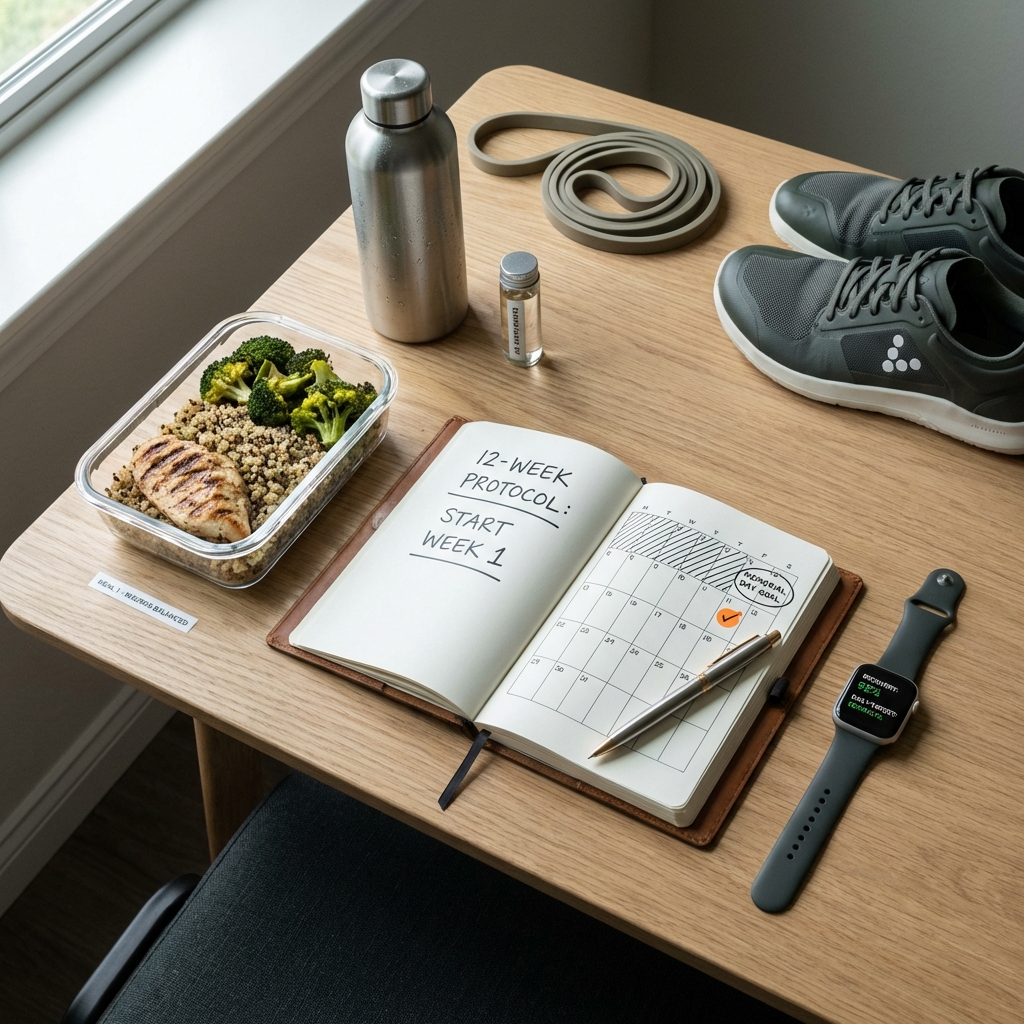
Memorial Day Is 12 Weeks Away. Here's What Your Body Can Actually Do in That Window.
I'm not here to guilt you about summer plans or beach season.
I'm here because 12 weeks is a real timeline. And most people have no idea what's actually achievable in that window when you stop guessing and start following a structured protocol.
The difference between someone who shows up confident on Memorial Day and someone who shows up with another excuse isn't motivation. It's understanding what the body does when you give it the right inputs at the right intervals.
The 12-Week Window Is Backed by Physiology
Research shows that 12 weeks of consistent training produces 10-20% increases in muscular strength and 8-12% improvements in cardiovascular fitness for previously sedentary individuals. Body fat decreases become visible after 6 weeks of consistent intervention, with continued improvements through week 12.
This isn't arbitrary.
It's the point where physiological changes become undeniable. Where your nervous system adapts, your metabolism recalibrates, and your body composition shifts in ways that photographs capture.
But here's what most people miss: the timeline isn't linear.
What You'll Notice First (And What Others Will See Later)
Your body talks to you before it talks to anyone else.
Most people notice internal changes within 2-4 weeks. Better energy. Reduced bloating. Clothes fitting looser. These aren't placebo effects. They're your body responding to consistent intervention.
Visual changes in photos and mirrors typically appear around 4-6 weeks. This is when you start seeing definition where there was softness. When your face looks different in the bathroom mirror.
Friends and family usually notice somewhere between 6-8 weeks. The CDC indicates you need to lose 5-10% of your initial body weight for visible changes to become noticeable to others. For a 180-pound person, that's 9-18 pounds before someone comments.
But here's the part that matters: muscle definition appears at the 8-12 week mark. Your nervous system adapts first. You feel stronger by week 2-4. But visible physique changes require the full 12-week window.
Why Starting Now Versus "After the Holidays" Actually Matters
Weight change trajectory from interventions involves rapid initial weight loss that slows between 3-6 months, eventually plateauing around 6 months.
Translation: your body is most responsive in phase one.
Those who delay miss the window when their body produces the most dramatic changes. Starting today versus "next month" doesn't just mean getting results 4 weeks earlier. It means capturing an entirely different physiological response window.
One review found that adults participating in short-term nutrition and physical activity programs (13 weeks or less) lost an average of 6 pounds more than non-participants. Every week of delay represents lost progress during your body's most responsive phase.
Real fat loss typically starts becoming visible after 3-4 weeks of consistent habits. Safe, sustainable weight loss happens at 1-2 pounds per week. Most people notice significant differences in themselves anywhere between 4-8 weeks with consistent intervention.
The first phase produces the most dramatic changes. Period.
The Procrastination Problem Nobody Talks About
Studies link procrastination to depression, anxiety, and low self-esteem. Approximately 80% of students and 25% of adults admit to being chronic procrastinators.
But here's what the research actually shows: trait procrastination undermines outcome and efficacy expectancies for achieving health-related goals. People who procrastinate literally struggle to imagine themselves succeeding, which becomes a self-fulfilling prophecy.
Procrastinating when it comes to health leads to higher risk of hypertension and cardiovascular disease. More than 50% of people stop using gym memberships within 6 months of starting. The pattern of delay creates compound harm, not just delayed results.
Starting now breaks this cycle.
Not because you suddenly have more willpower. But because you're giving your body the structure it needs to respond. At Ignite Medical Group, we've seen this pattern repeatedly: transformation requires structure, not willpower.
What 12 Weeks of Structured Intervention Actually Delivers
Here's what happens when you follow a medically supervised protocol instead of guessing:
Weeks 1-4: Internal Recalibration
Your body starts responding immediately. Energy stabilizes. Inflammation reduces. Sleep improves. Metabolic markers shift. You feel the changes before you see them.
This is when customized protocols and metabolic response monitoring matter most. Your body is learning a new baseline.
Weeks 5-8: Visual Confirmation
This is when photographs start telling a different story. Body fat decreases become visible. Muscle tone emerges. Your face changes shape. Clothes fit differently.
Protocol adjustments happen here based on how your body is responding. What worked in week 2 needs refinement by week 6.
Weeks 9-12: Compound Results
Muscle definition appears. Body composition changes become undeniable. This is when other people start commenting. When you look in the mirror and recognize a different version of yourself.
Research suggests that it takes 21 days to create a habit and 90 days to build a lifestyle. By month three of consistent intervention, most of the hard wiring of habits is in place. You've learned how to eat better, move more, and bounce back after setbacks without giving up.
This is the difference between temporary change and permanent transformation.
The Non-Linear Reality of Body Composition
While fat loss can be relatively linear, aesthetic results are decidedly non-linear.
At various body fat percentages, the body can look dramatically different. Someone might see modest scale changes but profound visual transformation. Or feel discouraged at week 6 only to see breakthrough changes at week 10.
This is why medical oversight and response monitoring matter. Your body doesn't read the textbook. It responds to your specific metabolic profile, stress levels, sleep quality, and hormonal environment.
We use body scanning technology and personalized weight loss tracking because guessing doesn't work. Your protocol needs to adapt as your body adapts.
What Integrated Care Actually Looks Like
At Ignite Medical Group, we don't separate body optimization from metabolic intervention from cellular restoration.
Someone arriving for body contouring often needs metabolic reset. Weight loss clients benefit from treatments that support inflammation reduction and pain relief. Aging clients want restoration of self-recognition, not frozen youth.
Our approach combines:
• Medical oversight with board-certified expertise
• Customized protocols based on your metabolic response
• Advanced technology like Alma Soprano Titanium for body contouring
• IV therapy for rapid absorption and cellular support
• No downtime treatments that allow immediate return to activities
• Response monitoring and protocol adjustments throughout your journey
We've built systems where laser precision, metabolic intervention, and cellular restoration function as one unified approach. Because real transformation requires comprehensive care, not episodic fixes.
The Memorial Day Math
12 weeks from now, you'll be somewhere.
You'll either be showing up with visible results and earned confidence. Or you'll be showing up with another story about why you didn't start.
The body is a feedback system. It responds to consistent input. It rewards structure over sporadic intensity. It transforms when you give it the right protocol at the right intervals.
Starting today captures the most responsive phase of physiological change. Waiting until "after the holidays" or "next month" means missing the window when your body produces the most dramatic results.
This isn't about guilt. It's about understanding what's actually possible when you stop guessing and start following a medically supervised protocol designed for lasting transformation.
Memorial Day is 12 weeks away. That's not a guilt trip. That's a timeline backed by research, refined by clinical experience, and proven by clients who chose structure over hope.
The question isn't whether 12 weeks is enough time. The question is whether you're ready to use it.