








Why Most People Choose AlmaTED Over Hair Transplants
I watch people's faces change when I show them what's possible without surgery.
Most of them found us through social media—a before-and-after post, maybe a video testimonial from a past client. They come in already curious about AlmaTED, though most admit they'd never heard of acoustic sound wave technology for hair restoration until they saw our results. Then I show them more photos from our own patients, walk them through how the science actually works, and something shifts.
The relief is visible.
Because most people don't actually want surgery—they want their hair back. They're relieved to discover those aren't the same thing.
The Problem with Normalizing Scalp Surgery
Hair transplants have dominated the conversation around hair restoration for so long that we've stopped questioning whether cutting into your scalp should be the default solution.
Let me be clear about what actually happens during a hair transplant.
Surgeons extract follicles from one part of your scalp and relocate them to thinning areas. Within six weeks, that "new" hair falls out—a normal but distressing phase called shock loss. Then you wait another five to six weeks before growth resumes.
The recovery constraints go beyond physical healing. You avoid vigorous exercise for at least three weeks. Some doctors recommend avoiding sexual activity for 10 days post-surgery. Scabbing persists for up to 10 days.
And here's what the marketing materials don't emphasize: shock loss can sometimes cause permanent reduction in your existing hair, particularly if you have miniaturized follicles in the transplant zone.
Most people take a week off work after hair transplant surgery—not because they physically need to, but because they want to avoid questions from colleagues.
That psychological burden matters.
What Changed My Approach to Hair Restoration
I started offering AlmaTED treatments because we were seeing a problem I needed to solve.
In our weight loss clinic, we were watching patient after patient lose their hair from GLP-1 medications. It was consistent enough that I knew I needed two things: a solution I could offer upfront to prevent the loss, and a treatment for people who'd already been on GLP-1s elsewhere and were dealing with the consequences.
That's how I found AlmaTED. And then something unexpected happened—it snowballed into an entire clientele base of its own because of the results we were getting. The demand got significant enough that we now run two AlmaTED devices.
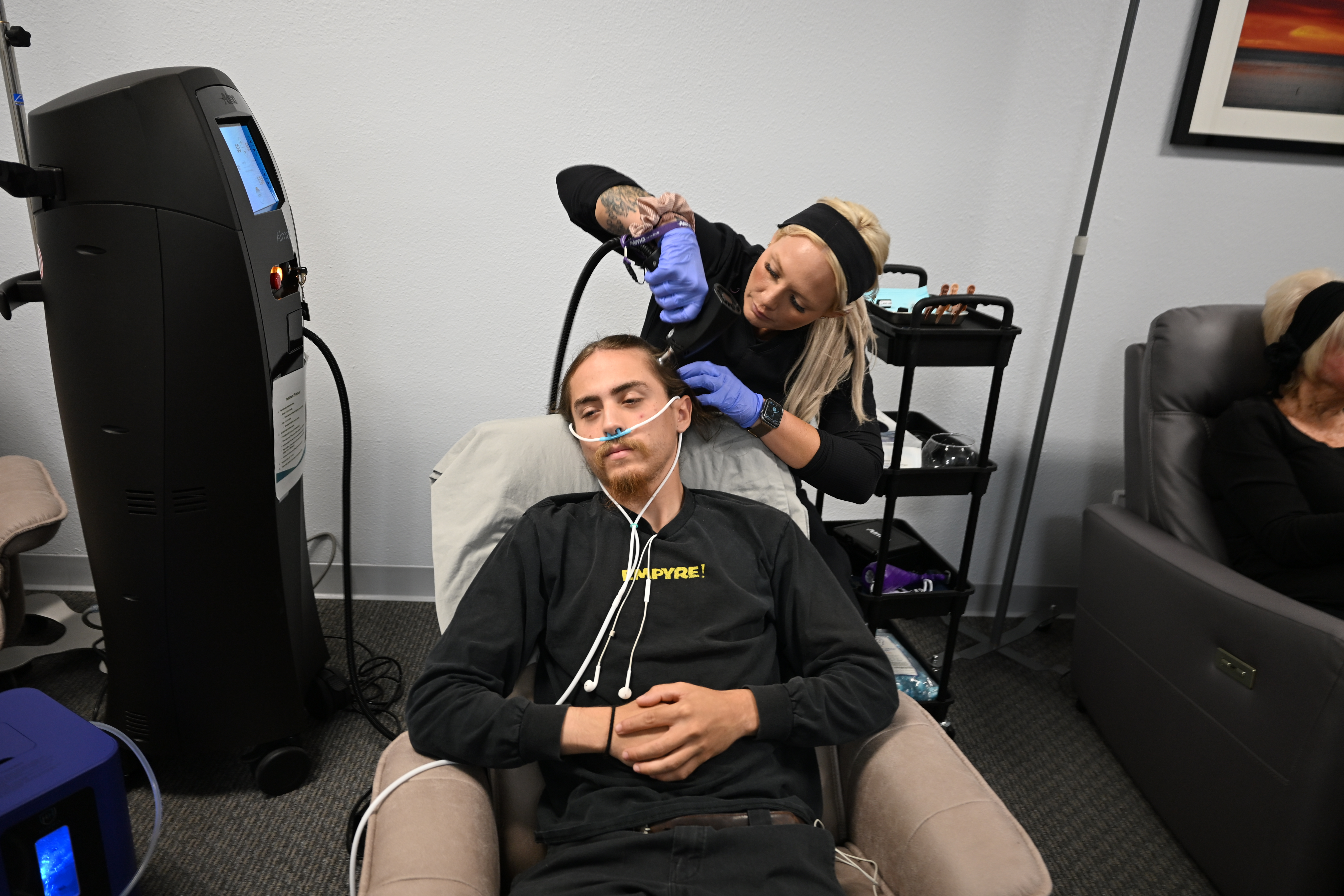
The AlmaTED system uses acoustic sound wave technology and air pressure to create temporary microchannels in the scalp. This allows for deep delivery of a specialized hair restoration serum while ultrasound waves increase blood flow and stimulate dormant follicles.
Research on inaudible sound at 30 kHz shows it significantly induces proliferation in human dermal papilla cells and outer root sheath keratinocytes—the cells responsible for hair growth. The technology triggers release of VEGF, a hair growth-related growth factor.
Translation: we're reactivating your existing follicles at the cellular level.
No incisions. No grafting. No shock loss.
What Actually Happens During Treatment
The consultation starts with examining your scalp and discussing realistic outcomes.
I'm direct about the timeline because managing expectations is part of the protocol. Hair doesn't respond overnight, and anyone promising instant results is selling fantasy, not science.
Most patients start with three treatments, one per month. Each session takes about 45 minutes. If you have more significant hair loss, we might recommend five or six treatments.
Here's what the progression typically looks like:
30 days after first treatment: You start noticing changes. Not dramatic transformation, but visible improvement.
60 days after second treatment: The results become more apparent. Hair texture changes. Density increases in treated areas.
90 days after third treatment: You see clear results. This is when most patients take their comparison photos.
4-6 months after first treatment: This is when the real transformation happens. The compounding effect of cellular stimulation and consistent treatment creates the density you were looking for.
Clinical studies show three AlmaTED treatments resulted in a 23% increase in hair density at one month and 31% at six months, with no pain or adverse events reported.
The treatment itself feels like a scalp massage. Patients can fall asleep during sessions.
That's not an exaggeration—it actually happens in my treatment room.
Why People Choose Non-Invasive Restoration
When someone discovers AlmaTED exists, the reaction is consistent: relief that they have an option that doesn't require surgery.
They're avoiding several specific things:
The permanence of surgical intervention. Once you commit to a hair transplant, you've made an irreversible decision about your donor site. With AlmaTED, you're working with your body's existing systems.
The social disruption. You walk out of an AlmaTED session and return to your normal activities immediately. No bandages. No visible evidence. No explaining to coworkers why you took a week off.
The physical trauma. Your body doesn't need to heal from incisions or recover from anesthesia. You're not managing pain or watching for infection.
The needle anxiety. AlmaTED doesn't involve microneedling or any needles at all. For people with needle phobia, this matters more than you might think.
The broader shift happening in medical aesthetics is that people want results without disruption to their identity or routine. Non-surgical hair restoration methods now represent 44% of the total hair restoration market, with adoption of non-invasive treatments increasing 28% between 2020 and 2024.
That's not just a trend. That's a fundamental change in how people approach body optimization.
The Education Gap Nobody Talks About
Here's what surprises me most: the majority of people who come in for AlmaTED consultations had no idea this technology existed.
They've researched hair loss extensively. They know about transplants, topical treatments, oral medications. But acoustic sound wave technology for follicle reactivation? Never heard of it.
The word just isn't out there yet.
I use a comprehensive presentation in consultations—Alma provided the framework, and it works because it translates complex cellular mechanisms into understandable outcomes. I show before-and-after progressions from our own patients who gave permission to share their journey.
When people see what's possible, they typically want to start treatment immediately.
But I also talk about what enhances results. Red light therapy can increase hair growth by 30%, so patients who pair AlmaTED with red light therapy sessions see even better outcomes. We also discuss Nutrafol supplementation for patients who aren't already taking hair-specific supplements.
This is about building a complete system for hair restoration, not just offering a single treatment.
When Surgery Still Makes Sense
I'm not suggesting AlmaTED works for everyone in every situation.
Some patients have advanced hair loss patterns where follicles are no longer viable for reactivation. Some have scarring or conditions that require surgical intervention. Some want immediate density in specific areas and understand the trade-offs involved.
Being honest about limitations builds more trust than claiming universal effectiveness.
But for the majority of people experiencing hair thinning, early-stage loss, or reduced density, non-invasive cellular restoration delivers results without requiring them to become surgical patients.
What This Shift Actually Means
The growth of non-invasive hair restoration reflects something deeper than convenience.
People are rejecting the idea that body optimization requires suffering, downtime, or dramatic intervention. They're looking for treatments that work with their existing biology rather than overriding it.
Hair loss isn't just about follicle health. It's about the disconnect between how you feel internally and what you see in the mirror. When someone says they want hair restoration, what they're really asking for is restoration of self-recognition.
That's why the consultation process matters so much. I'm not just assessing scalp health—I'm understanding what this person is trying to reclaim.
Transformation requires structure, not just willpower. That's why we space treatments one month apart. That's why we discuss the treatment response timeline upfront—you'll start seeing results within 30 days, with progressive improvement at 60 and 90 days, and full transformation by months four through six. That's why we recommend treatment packages based on individual scalp assessment.
Real results compound through repetition, not intensity.
The Four-to-Six-Month Reality
I tell every patient the same thing: the magic happens between months four and six.
That's when the cellular stimulation, increased blood flow, and consistent treatment schedule create visible transformation. That's when density improves enough that you see it in photos. That's when other people start noticing without knowing why you look different.
This isn't about instant gratification. It's about working with your body's natural timeline to create sustainable results.
The patients who get the best outcomes are the ones who understand this. They commit to the protocol. They show up for monthly treatments. They pair AlmaTED with complementary approaches like red light therapy.
And they end up with results that don't require them to become surgical patients.
Why I Changed How I Talk About Hair Restoration
I used to frame hair restoration conversations around what was available. Now I frame them around what's possible.
That's a significant shift.
When you have technology that delivers measurable results without surgery, without downtime, without needles, and without permanent commitment to a surgical solution, the entire conversation changes.
You're no longer asking "Are you willing to undergo surgery?" You're asking "Are you ready to commit to a treatment protocol that works with your body's existing systems?"
Most people answer yes to the second question who would have said no to the first.
The relief on their faces when they realize they have options tells me everything I need to know about whether we've normalized the wrong solution for too long.
Hair restoration doesn't require becoming a surgical patient. It requires understanding what's actually happening at the cellular level and choosing treatments that address the root cause rather than just relocating the problem.
That's what AlmaTED does. And that's why most people, when they learn it exists, choose it over surgery.
Ready to explore non-invasive hair restoration? Learn more about AlmaTED treatments at Ignite Medical Group.