








Why Your Hair Restoration Results Disappear (And What Actually Works)
We've watched so many clients walk into consultations carrying the same frustration.
They spent money on hair restoration treatments. They followed the application instructions. They waited the recommended time.
And the results? Barely noticeable. Or worse, the shedding continues.
The problem isn't the technology. It's how most providers apply it.
The "Treat and Hope" Approach
Most spas and wellness centers operate on a simple model: apply the same protocol to every client and hope it works.
You come in for hair restoration. Someone looks at your scalp. Maybe they ask a few questions about when your hair loss started. Then they apply a generic treatment protocol. Same settings, same duration, same approach they used on the last ten clients.
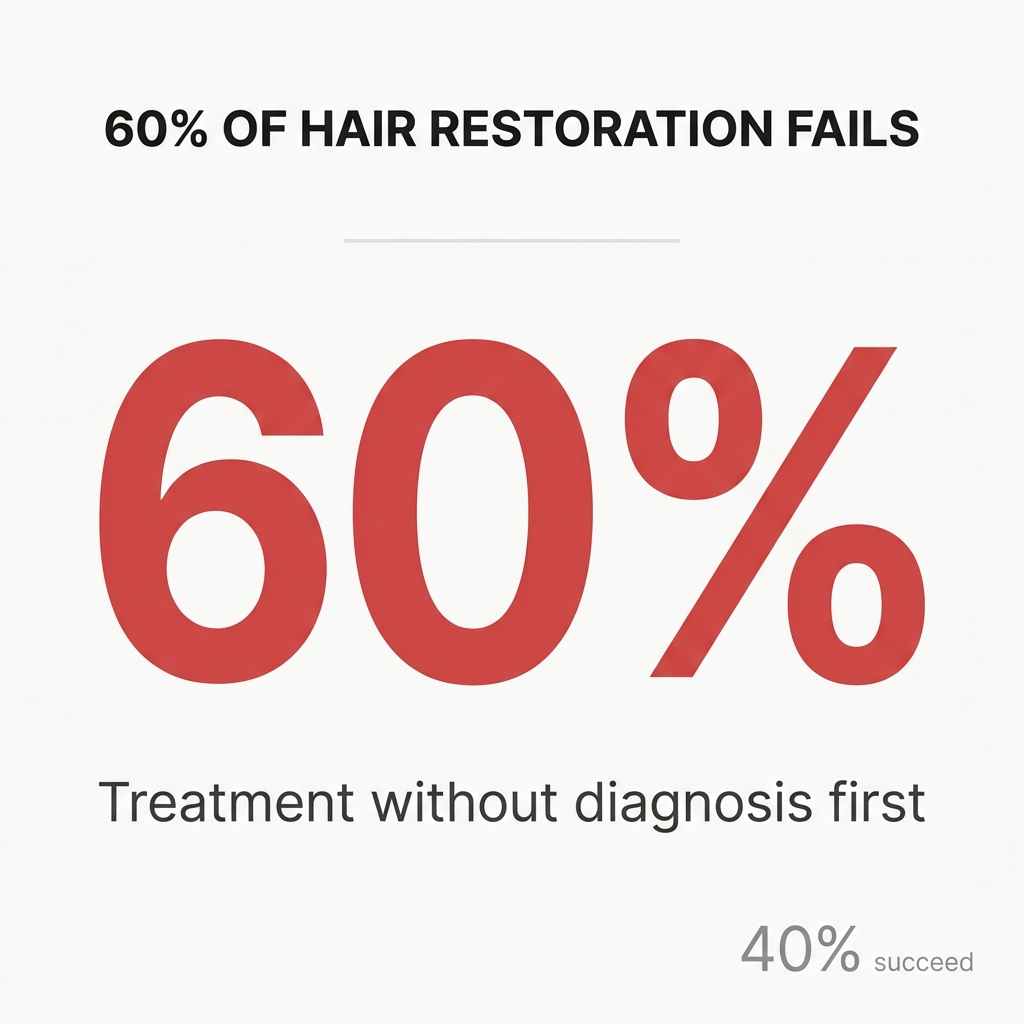
This approach has a name in the medical community: treatment without diagnosis.
And it leads to measurable failure.
Research confirms that up to 60% of hair loss treatments fail to produce expected results, primarily because patients begin treatment without understanding why their hair is falling out. Each year, millions spend thousands on ineffective remedies while their hair follicles continue deteriorating from unidentified underlying causes.
The data is clear: when you apply treatments without diagnostic precision, you get inconsistent outcomes.saQ
What Your Scalp Environment Actually Tells You
Here's what most providers miss: scalp health determines treatment response more than hair loss pattern.
Two people can have identical thinning patterns and completely different scalp conditions. One has healthy follicles ready to respond to stimulation. The other has inflammation blocking nutrient delivery to the follicle.
The first responds to treatment within weeks. The second sees no improvement because the scalp environment prevents follicle function.
Hair loss treatments often underperform not because of the product itself, but because the scalp environment wasn't ready. By addressing congestion, inflammation, and microcirculation first, the same treatment can produce measurable improvement.
This means effective hair restoration requires assessment. Identifying your specific scalp condition and the type of hair loss you're experiencing.
Generic protocols can't do this. They're designed for average patients that don't exist.
The Diagnostic Gap in Hair Restoration
We started using Alma TED for hair restoration because we needed technology that matched medical-grade standards.
The system uses ultrasound-based acoustic sound waves combined with air pressure to deliver essential nutrients deep into the scalp. It's FDA-cleared as a Class 1 device. The lowest risk classification possible.
Compare that to invasive procedures requiring incisions, anesthesia, and recovery time.
But the real value isn't just the technology. It's how that technology functions within a diagnostic framework.
When we assess a client for Alma TED treatment, we evaluate their complete hair loss profile. Identify whether they're experiencing androgenetic alopecia, telogen effluvium, or another pattern. Assess scalp health, looking for inflammation, congestion, or circulation issues that could block treatment response.
This diagnostic foundation changes everything about treatment planning.
We know whether someone is a good candidate. We can predict their response timeline. We can address scalp preparation needs before beginning Alma TED sessions. We can integrate complementary treatments when indicated.
Why Results Take Months (And Why That Matters)
Non-surgical hair restoration doesn't work like a hair transplant.
You don't walk out with immediate visible changes. Your follicles need time to respond to stimulation. The hair growth cycle takes weeks to months.
This timeline creates a problem: without proper assessment and guidance, you can't tell if the treatment is working or if underlying factors are preventing response.
Did your hair density improve because the treatment worked? Or are you experiencing natural growth cycle variation? Did the treatment fail? Or is your nervous system preventing your body from responding?
Most clients can't answer these questions. They're left guessing.
Comprehensive assessment solves this. Baseline evaluation establishes your starting point. Progress tracking identifies response patterns. Detailed consultation reveals factors that could affect results. Clinical observation catches issues before they derail outcomes.
This structured approach transforms the client experience. Instead of wondering if it's working, you have data.
The Consultation That Changes Everything
Here's something most people don't think about: who's actually qualified to guide your hair restoration journey?
Hair restoration isn't just cosmetic. It's biological. Your nervous system function affects hair growth. Stress responses impact follicle health. Your body's ability to heal and regenerate determines treatment outcomes.
These factors require proper evaluation.
But many spa-based providers operate without understanding these connections. They apply treatments without discussing the whole picture. They miss the nervous system factors that no treatment protocol can overcome alone.
This matters because your body's internal state determines your treatment response.
How your nervous system functions. How your body responds to stress. Your body's healing capacity. Your overall wellness state. These factors directly impact follicle function. If they're working against you, even the best hair restoration technology won't produce results.
Someone needs to discuss these factors with you before treatment. They need to understand your health background, your lifestyle, and any factors that could affect outcomes.
At Ignite, every hair restoration protocol starts with comprehensive consultation. We discuss your nervous system health and how it affects hair growth. We examine your scalp in detail. We educate you thoroughly about how TED works and what to expect. We determine if you're positioned for success.
This isn't just better practice. It's the difference between effective treatment and wasted time.
What Diagnostic-Driven Hair Restoration Actually Looks Like
When you start Alma TED hair restoration at Ignite, we begin with a complete assessment.
We review your hair loss history. We examine your scalp for signs of inflammation, miniaturization patterns, or other indicators. We assess whether you're experiencing androgenetic alopecia, diffuse thinning, or another pattern.
Then we determine if you're a good candidate for Alma TED.
If you have early to moderate hair thinning with healthy follicles, Alma TED offers excellent potential.
We establish a treatment protocol. Typically a series of sessions spaced according to your hair growth cycle. We integrate the TED+ Hair Care Formula to maximize nutrient delivery. We track response and adjust as needed.
Every Alma TED client at Ignite receives unlimited access to two complementary therapies that accelerate results: medical-grade red light therapy and hydrogen therapy.
We use the New Wave Light Therapy system, an FDA-cleared medical-grade red light device. Red light therapy works through photobiomodulation, delivering red and near-infrared wavelengths that penetrate deep into the scalp to boost cellular energy production, enhance circulation, and reduce inflammation. This creates an optimal environment for follicle function and supports the regenerative effects of Alma TED.
We also provide unlimited hydrogen therapy. Molecular hydrogen acts as a selective antioxidant, reducing oxidative stress in hair follicles without disrupting cellular functions. Research shows that hydrogen therapy cleanses keratin plugs that clog hair follicles, promotes capillary blood flow to the scalp, and helps neutralize harmful free radicals that can damage follicles and disrupt the hair growth cycle.
Both modalities are available to all TED clients without restriction. Those who use them consistently see faster results. Those who don't will still see improvement, just on a slower timeline.
This integration reflects our understanding: hair restoration isn't a single intervention. It's creating the conditions where your follicles can function optimally.
This approach takes longer than "book a package and hope." But it delivers results that last because it's built on diagnostic precision instead of guesswork.
The Technology Validation That Matters
We chose Alma TED because the clinical data is unambiguous.
In one clinical study with 31 participants, three treatments resulted in a 23% increase in hair density at one month and 31% at six months, indicating early and sustained terminalization across all treated areas, with no pain or adverse events reported.
In another study with 50 participants, three treatments yielded outstanding results: 98% of patients reported reduced shedding, 96% noted increased hair growth, 89% observed visible improvement in hair density, and 100% expressed high satisfaction.
The technology uses ultrasound energy and air pressure. Completely non-invasive. No needles. No pain. No downtime.
Most competing technologies require discomfort, recovery time, or ongoing maintenance that clients can't sustain.
The Acceleration Advantage: Red Light and Hydrogen Therapy
Here's what sets our approach apart: we don't stop at Alma TED.
Every client receives unlimited access to medical-grade red light therapy using the New Wave Light Therapy system. This FDA-cleared technology delivers specific wavelengths that enhance cellular energy production, improve scalp circulation, and reduce inflammation at the follicle level.
The science is straightforward. Red light therapy triggers photobiomodulation. Light energy penetrates scalp tissue and stimulates mitochondria in hair follicle cells. This increases ATP production, the cellular energy that drives hair growth. Improved blood flow delivers more nutrients to follicles. Reduced inflammation creates a healthier growth environment.
We pair this with unlimited hydrogen therapy. Molecular hydrogen targets oxidative stress, one of the primary factors in hair follicle deterioration. Studies show that hydrogen therapy cleanses keratin plugs from hair pores, promotes capillary blood flow more effectively than standard treatments, and protects follicles from free radical damage.
Research published in medical journals demonstrates that hydrogen warm water cleanses keratin-plugged hair pores and promotes capillary blood flow more markedly than normal treatments. The molecular hydrogen works as a selective antioxidant, neutralizing harmful free radicals while supporting cellular health and scalp circulation.
These aren't optional add-ons we charge extra for. They're integrated into every TED protocol because they accelerate the biological processes that drive hair restoration.
Clients who use both modalities consistently see results faster. The combination creates compound effects. Alma TED stimulates follicles. Red light therapy optimizes cellular energy. Hydrogen therapy reduces oxidative stress. Together, they create the ideal environment for sustained hair growth.
This is why some clients see visible improvement in weeks while others take months. Consistency with complementary therapies matters.
What This Means for Your Next Treatment Decision
If you're considering hair restoration, ask these questions before you book:
How do you determine what's causing my hair loss? If the answer is "we look at your scalp," you're getting generic treatment.
What diagnostic assessment do you perform? If they don't evaluate your specific hair loss pattern and scalp health, they're guessing about your candidacy.
Who guides your treatment protocol? If they don't understand the nervous system connection to hair health or take time for detailed consultation, you're missing critical context.
How do you determine if I'm a good candidate? If they don't screen for contraindications or assess follicle viability, they have no basis for predicting results.
What happens if I'm not responding as expected? If they don't have a system for clinical evaluation and protocol adjustment, you're locked into an approach that might not work for your physiology.
These questions reveal whether a provider operates on diagnostic precision or the "treat and hope" model.
The Restoration That Actually Lasts
Hair restoration works when it's applied with medical precision to your specific condition.
It fails when providers skip the diagnostic step and apply generic protocols to complex medical conditions.
At Ignite, we built our approach around a simple principle: you can't treat what you don't diagnose.
We start with comprehensive assessment. We determine candidacy based on your hair loss pattern and scalp health. We apply Alma TED within a medical framework. We track progress clinically. We adjust when needed.
This takes more time than booking a treatment package online. But it delivers the results that made you consider hair restoration in the first place.
The difference between restoration and disappointment is diagnostic precision.
Everything else is just hope.
Ready to see what diagnostic-driven hair restoration can do for you? Schedule a comprehensive assessment at Ignite Medical Group. We'll evaluate your hair loss pattern, assess your scalp health, and determine if Alma TED is right for your specific condition. Book your consultation in San Marcos today.