









Why Your Skin Looks Dull Even After Expensive Treatments
TL;DR: Expensive creams and fillers can't fix dull, aging skin because they don't address the root cause: structural collagen loss that accelerates after age 25. Collagen creams can't penetrate skin barriers, and fillers only add temporary volume without rebuilding your skin's foundation. Hybrid laser resurfacing targets both surface texture and deep collagen infrastructure, triggering your body's natural regeneration process over 3-12 months for lasting restoration instead of temporary coverage.
Core Answer:
Your skin loses 1-1.5% of collagen yearly after age 25, causing structural collapse, not just cosmetic decline
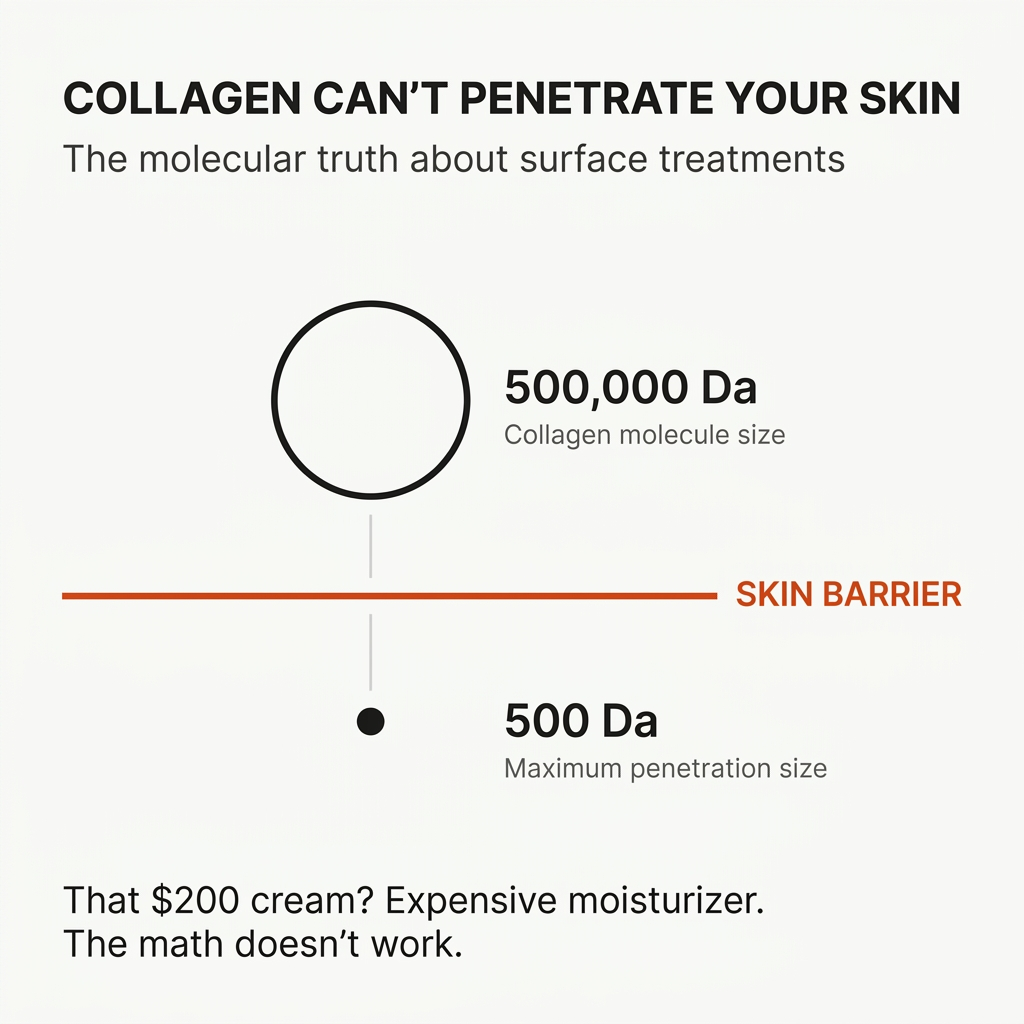
Collagen creams cannot penetrate skin barriers (they're too large at hundreds of thousands of Daltons vs. the 500 Dalton limit)
Fillers add temporary volume for 6-18 months but don't restore skin quality or stop cellular breakdown
Hybrid laser resurfacing creates controlled damage at multiple depths, triggering collagen production and dermal remodeling over 3-12 months
Restoration takes time because you're rebuilding infrastructure, not masking symptoms
Why Does Skin Look Dull Despite Expensive Treatments?
I've watched people spend thousands on serums, peels, and injectables, only to stand in front of the mirror six months later asking the same question: "Why doesn't my skin look like me anymore?"
The answer lives deeper than most treatments reach.
Your skin loses approximately 1% to 1.5% of its collagen every year after your mid-twenties. By the time you're in your eighties, your skin produces 68-75% less collagen than it did in your twenties.
This isn't cosmetic decline. This is structural collapse.
Most treatments you've been offered are designed to hide this collapse, not fix it.
The Reality: Structural collagen loss accelerates after age 25, creating foundation failure that surface treatments cannot address.
Why Can't Collagen Creams Penetrate Your Skin?
Here's what the aesthetics industry doesn't advertise clearly enough.
That $200 collagen cream you bought? It can't penetrate your skin barrier. The molecular weight of collagen is hundreds of thousands of Daltons. Your skin only allows substances under 500 Daltons to pass through.
The math doesn't work.
These products function as expensive moisturizers. They hydrate the surface. They create temporary plumpness. But they cannot replace the collagen your body stops producing.
You're treating a structural problem with a surface solution.
Bottom Line: Collagen molecules are too large (hundreds of thousands of Daltons) to pass through your skin barrier (500 Dalton limit), making expensive creams function only as temporary moisturizers.
What Is the Collagen Breakdown Cycle?
What happens beneath your skin creates a vicious cycle most people never hear about.
As collagen fragments with age, your fibroblasts—the cells responsible for producing new collagen—lose their attachment sites. Without proper attachment, they collapse. Collapsed fibroblasts produce less collagen and increase the activity of matrix metalloproteinases (MMPs), the enzymes that break down collagen.
Less collagen leads to more breakdown, which leads to even less production.
This self-reinforcing loop accelerates everything you see in the mirror: decreased elasticity, thinning skin, deepening wrinkles. Your body isn't just aging—it's losing the infrastructure to repair itself.
Surface treatments don't interrupt this cycle. They decorate around it.
The Cycle: Fragmented collagen causes fibroblast collapse, which increases collagen-destroying enzymes (MMPs) and decreases new collagen production—a self-reinforcing loop that accelerates visible aging.
Why Don't Fillers Restore Skin Quality?
I understand the appeal of fillers. Immediate results. Visible lift. The promise of looking like yourself again.
But here's what you're actually getting: temporary volume that does nothing for skin quality.
Fillers plump. They don't restore. They add material where structure has collapsed, but they don't rebuild the foundation. Results last 6-18 months, then you're back for more. You're renting improvement, not investing in regeneration.
Meanwhile, your skin quality continues declining underneath the filler.
This isn't judgment. This is recognition that you've been offered a solution designed for a different problem. Fillers address volume loss. They don't address the cellular breakdown causing your skin to lose its integrity.
The Limitation: Fillers add temporary volume (6-18 months) without rebuilding foundation or stopping the ongoing cellular breakdown underneath.
What Does Real Skin Restoration Require?
Real restoration demands a different approach entirely.
You need to trigger your body's wound healing cascade—the same process that reorganizes collagen after injury. This process takes time. Up to 12 months for full dermal remodeling.
You need to activate fibroblasts at the depth where collagen production actually happens. Surface treatments can't reach this layer. Fillers bypass it entirely.
You need precision that creates controlled damage without excessive downtime, because most people can't afford two weeks of recovery.
This is where hybrid laser technology becomes relevant.
The Requirements: True restoration needs to trigger wound healing cascades, activate deep fibroblasts where collagen forms, and create controlled damage with minimal downtime—all over a 3-12 month remodeling period.
How Hybrid Lasers Work Differently
Hybrid fractional laser systems operate on dual-depth precision.
The fractional CO2 component creates microchannels in your skin. These aren't random—they're precisely controlled zones of damage that remove compromised tissue and trigger immediate collagen production.
The non-ablative 1570 nm component delivers heat deeper into your dermis without disrupting the surface. This stimulates long-term remodeling in the layers where your collagen infrastructure lives.
You're addressing both immediate texture and deep structural integrity in one treatment.
The data shows this matters. Hybrid systems demonstrate an 80% overall improvement rate compared to 65% for traditional CO2 lasers. Wrinkle depth reduces by 40% with hybrid treatment versus 21% with CO2 alone. Recovery time drops from 14 days to 7-10 days.
You get better results with less disruption.
The Timeline Your Skin Actually Follows
Here's what happens after hybrid laser resurfacing.
Immediate (Days 1-7): Your skin initiates the wound healing cascade. You'll see redness and peeling as compromised tissue sheds and regeneration begins.
Early visible improvement (Weeks 2-8): Texture smooths. Fine lines soften. Your skin looks clearer and feels firmer as surface remodeling takes effect.
Deep restructuring (Months 3-12): The deeper work continues beneath what you can see. Fibroblasts keep producing collagen. Your dermal infrastructure strengthens progressively. Results continue building long after the visible healing completes.
You see improvement quickly. But the full structural restoration? That takes time.
This distinction matters because it changes your expectations correctly. You're not waiting months to see results. You're seeing results while your skin continues rebuilding underneath.
Why We Use Three Treatments Instead of One Aggressive Session
At Ignite, we don't sell hybrid laser resurfacing as a single aggressive treatment.
We structure it as three mild-to-moderate sessions spaced five to six weeks apart.
Here's why that protocol matters.
One aggressive treatment gives you dramatic results—and dramatic downtime. Think two weeks of serious recovery, significant discomfort, and a timeline that disrupts your life.
Three gentler treatments give you the same cumulative collagen remodeling without the brutal recovery. Each session builds on the previous one. Each treatment delivers visible improvement you'll notice immediately.
After your first treatment: Clients consistently report better texture, smoother tone, and visible reduction in fine lines. You're already seeing results.
After your second treatment: The improvements deepen. Skin firmness increases. Lines that softened after treatment one continue improving.
After your third treatment: You're seeing the full structural transformation. But here's what most people miss—the collagen remodeling continues for months after your final session.
This approach works because you're giving your skin repeated signals to rebuild, not one traumatic injury to recover from. Each treatment activates another wave of fibroblast activity. Each session triggers additional collagen synthesis.
You get immediate satisfaction after every treatment and long-term structural restoration over the full timeline.
The spacing matters too. Five to six weeks gives your skin time to complete its acute healing response before the next session. You're not interrupting recovery—you're layering regeneration.
This isn't about making treatments easier to sell. It's about matching intervention intensity to what your skin can actually process without excessive damage.
You leave each session seeing improvement. You return for the next session knowing the protocol works. By the time you complete all three treatments, you've built progressive results that continue compounding for months.
Same outcome as aggressive treatment. Better experience. Faster return to normal life.
What This Means for Your Decision
You have a choice between two fundamentally different approaches.
You can continue adding volume to compensate for structural loss. This works temporarily. It requires ongoing maintenance. It doesn't address the underlying degradation.
Or you can invest in rebuilding your skin's infrastructure. This takes longer. It requires patience through the remodeling process. But it addresses the actual problem—the collapse of your collagen matrix.
One approach masks what's missing. The other restores what's broken.
I've built our laser protocols around restoration because I've watched what happens when people choose structural intervention over cosmetic compensation. They don't just see improvement—they recognize themselves again.
That recognition matters more than any single measurement of wrinkle depth or skin thickness.
The Infrastructure Question
Your skin is a feedback system, not a cosmetic surface.
When you treat it as decoration, you get decorative results. When you treat it as living tissue with specific regenerative requirements, you get structural improvement.
Hybrid laser resurfacing isn't the only answer for everyone. But if you've spent years trying surface solutions and watching them fail, if you've considered fillers but hesitated at the idea of ongoing injections, if you want your skin to actually function better instead of just looking temporarily fuller—this approach deserves your attention.
The science supports it. The timeline is honest. The results compound over months instead of fading over weeks.
Your skin lost its structure gradually. Restoration follows the same timeline.
We're not offering quick fixes at Ignite Medical Group. We're offering the kind of intervention that matches how your body actually rebuilds tissue. Precision technology, clinical protocols, and realistic expectations about what restoration requires.
If you're ready to address what's actually breaking down instead of covering what's already broken, contact us to talk about what hybrid laser treatment looks like for your specific situation.
Book a consultation in San Marcos. We'll assess your skin's current state, explain what's realistic given your timeline, and design a protocol that matches your restoration goals.
You've tried the surface approach. You know where it leads.
Maybe it's time to go deeper.