









Your Body Doesn't Read the Scale: What GLP-1 Medications Are Actually Fixing
I've been watching something unfold in the medical community that challenges how we think about these medications.
GLP-1 drugs like Wegovy and Zepbound became famous for weight loss. The numbers on the scale made headlines. But a study published last week revealed something that changes the conversation entirely.
Some people don't lose significant weight on these medications. And their bodies are healing anyway.
The Data That Rewrites the Story
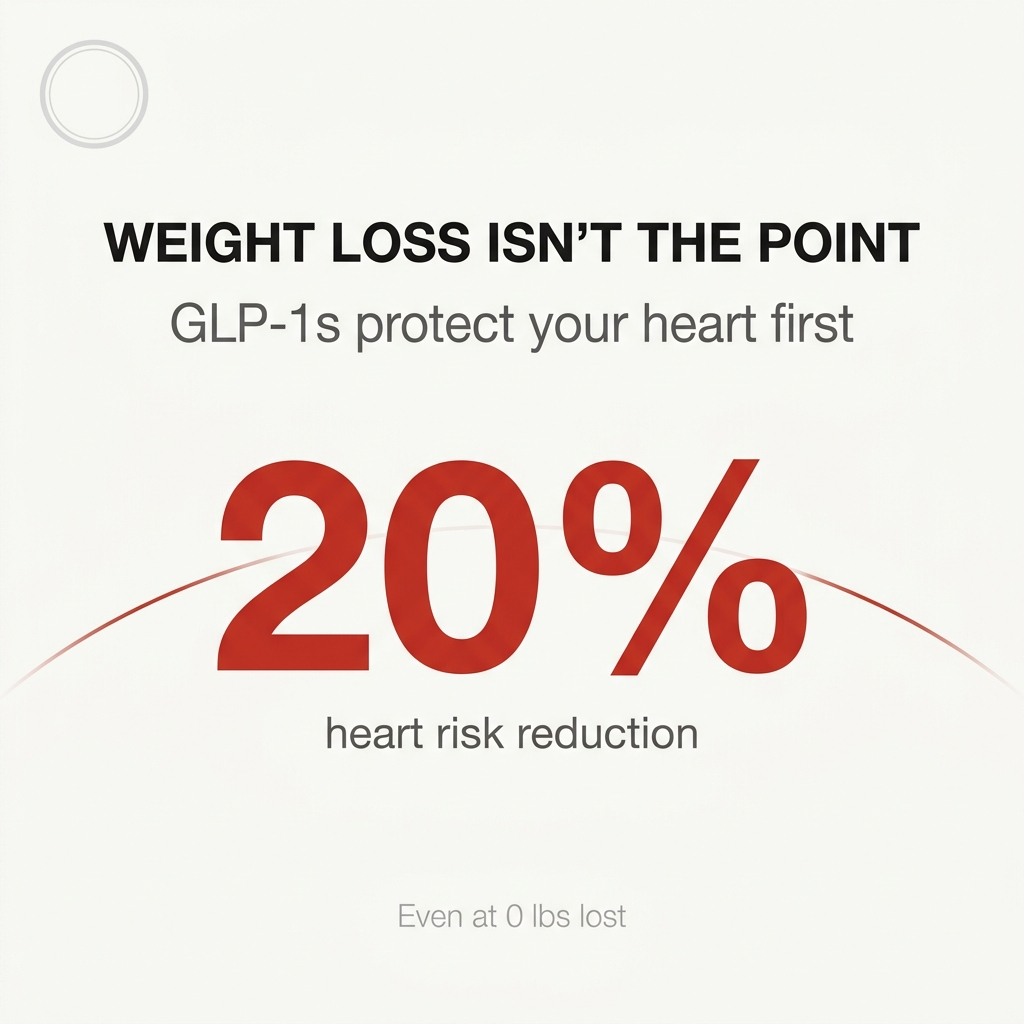
Researchers found that cardiovascular protection begins before weight loss occurs. Patients who previously had a heart attack or stroke showed reduced risk of another cardiac event within 3 months of starting Wegovy. The decreased risk appeared before significant weight loss happened.
The reduction in heart attack or stroke risk reached about 20% for patients with prior cardiac events.
This tells us something critical about how these medications work. They address metabolic dysfunction at the cellular level, not just caloric balance.
Stacking Benefits on Top of Standard Care
Here's what caught my attention in the cardiovascular research.
Adding GLP-1 receptor agonists to proven cardiovascular medicines results in a 10-20% further reduction in rates of heart attacks, strokes, and deaths. This happens on top of excellent cardioprotective standard care.
Patients with type 2 diabetes taking oral semaglutide were 14% less likely to experience cardiovascular death, heart attack, or stroke over an average follow-up of 4 years compared with placebo.
The body responds to these medications through mechanisms we're still mapping. Weight loss is one outcome. Cardiovascular protection is another. They don't always move in lockstep.
The Liver Tells a Different Story
Fatty liver disease affects millions of people. It develops when the liver accumulates excess fat, often driven by insulin resistance and metabolic dysfunction.
After 72 weeks, treatment with semaglutide at a dose of 0.4 mg/day resulted in the histological resolution of NASH without progression of fibrosis in 59% of patients. Only 17% in the placebo group achieved this.
An improvement in NAS was observed in 83% of patients treated with semaglutide.
The mechanism goes beyond weight reduction. GLP-1 medications improve insulin resistance, which is a primary driver of fatty liver disease. Better insulin sensitivity means less fat is directed to the liver for storage. This breaks the cycle that feeds the disease.
Your liver doesn't care what the scale says. It responds to metabolic signals.
Heart Failure Patients See Real Improvement
For obese patients with chronic heart failure, GLP-1 receptor agonists showed significant results for worsening heart failure events. The odds ratio was 0.43, with a 95% confidence interval of 0.30-0.59.
Starting a GLP-1RA was associated with a lower 3-year absolute risk of heart failure hospitalization than starting a DPP-4i. The risk was 3.4% versus 4.3%, corresponding to a weighted hazard ratio of 0.77.
These patients experience symptom improvement and reduced hospitalizations. The benefits appear partly independent of the degree of weight loss achieved.
The Anti-Inflammatory Mechanism We Overlooked
Evidence is mounting to show that even people who don't experience weight loss can see benefits related to the heart, kidney, and liver.
GLP-1 medicines improve outcomes in people with cardiovascular, kidney, liver, arthritis, and sleep apnea disorders. These actions are mediated in part through anti-inflammatory and metabolic pathways. Some benefits are partly independent of the degree of weight loss achieved.
GLP-1 agonists produce multiple beneficial effects, which include anti-inflammatory action along with anti-atherogenic effects, endothelial-protective benefits, and cardioprotective actions to minimize major adverse cardiovascular events.
Chronic inflammation plays a key role in fibrosis and organ damage in the heart and liver. Reducing inflammatory signaling protects tissues even without acting directly on muscle or liver cells.
This reveals that GLP-1s function as systemic metabolic modulators rather than simple appetite suppressants.
The Genetics Question
The study published last week suggests genetics may play a role in who loses weight on these medications and who doesn't.
Some people are non-responders to the weight loss effect. Their bodies still receive cardiovascular protection, liver health improvements, and reduced inflammation.
This matters because it shifts how we evaluate treatment success. The scale is one data point. It's not the only one that counts.
The Sustainability Problem
Heart risks begin to return as soon as six months after stopping the drug. They may be almost completely eclipsed as soon as a year and a half after stopping.
After stopping, the heart benefits seemed to be reversed more quickly than it took to get them in the first place.
Compared with those who remained on the drug, people who discontinued GLP-1 medication had a 4% increase in heart risks six months after going off the drug, a 14% increase in risk at a year off the medication, and a 22% increase in risk by the second year.
This underscores the importance of viewing GLP-1 therapy as part of a comprehensive, sustained metabolic optimization strategy rather than a short-term intervention.
Your body doesn't store the benefits. It responds to ongoing metabolic signals.
What This Means for Treatment Decisions
Dr. Daniel Drucker from the University of Toronto argues that weight loss is not the whole story. Health insurers and government programs should consider these other benefits in their coverage decisions.
I agree with this perspective.
When you evaluate GLP-1 medications solely on weight loss outcomes, you miss the broader metabolic reset happening in the body. You overlook the cardiovascular protection that begins before the scale moves. You ignore the liver healing that occurs independent of fat loss.
The body is a feedback system. These medications address multiple signals simultaneously. Some people respond with dramatic weight loss. Others experience metabolic improvements without significant weight change.
Both groups deserve access to treatment.
The Bigger Picture
This research points toward a future where we understand GLP-1 medications as preventative medicine tools, not just weight management drugs.
The cardiovascular benefits alone justify consideration for patients with metabolic syndrome, even if weight loss is modest or absent. The liver protection matters for the millions dealing with fatty liver disease. The anti-inflammatory effects reach multiple organ systems.
We're learning that metabolic health operates through interconnected pathways. Addressing one pathway creates ripple effects throughout the system. Weight is one marker of metabolic function. It's not the only one worth tracking.
Your body knows what it needs. Sometimes that shows up on the scale. Sometimes it shows up in blood work, imaging studies, and reduced disease progression.
The scale doesn't tell the whole story. It never did.