









Your Self-Image Is a Thermostat. Here's What the Research Says About Turning It Up.
Maxwell Maltz was a cosmetic surgeon who noticed something strange.
He'd perform successful surgeries that completely transformed his patients' outward appearance. The procedures worked. The results were visible.
But many patients wouldn't end up any happier.
Their outward appearance would change, but their internal feelings and attitudes would remain the same. This observation led Maltz to groundbreaking research showing that self-image acts as a psychological thermostat that regulates what goals you'll pursue and what you'll accept for yourself.
The thermostat metaphor is precise. You act like the sort of person you conceive yourself to be. Your day-to-day behavior, emotions, and even the reactions you invite from others are both driven by and limited by your self-image.
The good news is that this inner thermostat is adjustable, albeit slowly.
The Income Premium of Physical Confidence
Self-image isn't just about how you feel. It shows up in measurable outcomes.
A longitudinal study tracking people from their mid-20s into their early 50s found that a 1 standard deviation increase in facial attractiveness is associated with log earnings that are 2.0 percentage points higher in 1975 and 3.3 percentage points higher in 1992. This held true even after controlling for IQ.
The attractiveness premium persists across decades. It's an enduring, positive labor market characteristic.
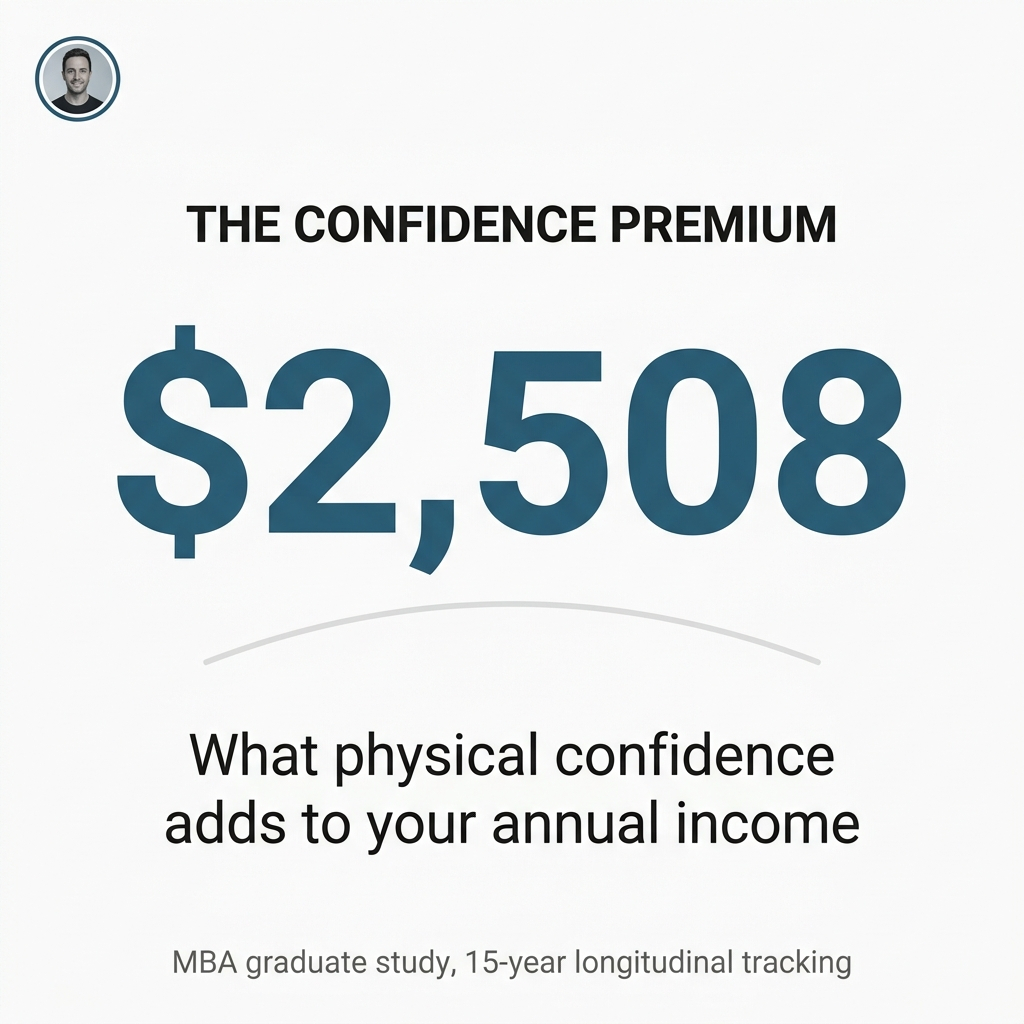
More recent research from 2025 tracking over 43,000 MBA graduates found that attractive MBA graduates enjoy a 2.4% beauty premium over 15 years, earning an average of $2,508 more annually. For the top 10% most attractive individuals, this premium increases to $5,528 per year.
Additionally, attractive individuals are 52.4% more likely to hold prestigious job positions 15 years post-graduation.
The mechanism isn't vanity. It's confidence.
Research documents that attractiveness is positively correlated with proxy measures of confidence, which is the channel emphasized in explaining the earnings premium. The connection between physical appearance and confidence creates positive self-evaluations for promoting emotionally risky behaviors like self-disclosure that can maintain and strengthen relationships.
Physical appearance affects income partly because attractive people might also earn more partly because they become more educated and view themselves more positively. It's a self-reinforcing cycle of confidence and achievement.
The Relationship Quality Connection
The thermostat effect extends beyond your career.
A comprehensive meta-analysis found that body satisfaction was positively associated with marital satisfaction (r = 0.43) while body dissatisfaction was negatively associated with marital satisfaction (r = −0.19).
These effects work through both direct pathways and through sexual satisfaction as a mediator.
Research on couples demonstrated that within individuals, a more positive body image was linked to higher perceived romantic relationship quality through greater sexual satisfaction. This pattern held equally for both men and women.
Studies show that women with poor body image may be less likely to engage in relationship promoting behaviors and thus may experience decreased satisfaction with their relationships because body image is an important component of global self-esteem that affects confidence in interpersonal abilities.
Your self-image doesn't just regulate what you pursue. It regulates how you show up in the relationships that matter most.
The Peptide Question
This brings us to a treatment category that's generated both interest and confusion: peptide therapy.
Therapeutic peptides now account for about 25% of the global pharmaceutical market with the peptide therapeutics market projected to exceed $70 billion by 2030, reflecting their increasing acceptance and clinical validation.
The FDA approved four new peptide therapeutics in 2024. Regulatory guidelines from FDA, EMA, and ICH now ensure the quality, efficacy, and safety of these biological products at every stage of the production process. Clinical trials show that most treatment-emergent adverse events with approved peptides were mild or moderate.
In 2026, HHS is moving to reclassify 12 peptides, allowing licensed compounding pharmacies to prepare them for patients under physician supervision, with a valid prescription, from compliant and quality-controlled sources.
The critical distinction is source and supervision.
The biggest peptide risks stem from contamination, mislabeling, and compounding inconsistencies in unregulated sources. FDA testing revealed that up to 40% of online and compounded peptides contained incorrect dosages or undeclared ingredients.
This makes physician-supervised, pharmacy-compounded peptides from FDA-registered 503B facilities essential for safety.
The Fears That Keep People Stuck
I've noticed three fears that stop people from exploring peptide treatment even when they're good candidates:
Fear of judgment. The concern that seeking help for weight management or body optimization means you've failed at willpower. This fear is rooted in the outdated belief that body transformation is purely a character issue rather than a biological one.
Fear of complexity. The treatment landscape feels overwhelming. Different peptides, different protocols, different claims. People don't know where to start or who to trust.
Fear of exposure. The idea of having to physically present yourself to strangers, explain your situation, and undergo evaluation feels vulnerable.
These fears are real. They're also addressable.
The Form-Based Path
The barrier-free approach starts with a simple qualification form.
You provide your health history, current medications, and treatment goals. A licensed clinical doctor reviews your information and determines if you're a candidate for peptide therapy.
No office visit required for initial qualification. No explaining yourself to a receptionist. No sitting in a waiting room wondering if people are judging why you're there.
If you qualify, the doctor approves your treatment plan. The pharmacy compounds your prescription from FDA-registered facilities. You receive clear instructions for administration.
Medical supervision continues throughout treatment. You're not left to figure it out alone. But the initial barrier of having to physically present yourself before knowing if treatment is even appropriate gets removed.
This matters because the people who would benefit most from peptide therapy are often the ones most hesitant to pursue it due to the vulnerability involved in traditional consultation models.
What Peptides Actually Do
GLP-1 peptides work through multiple pathways.
They stabilize blood sugar levels. They improve insulin sensitivity. They regulate appetite by working through the brain's satiety centers. They delay gastric emptying. They reduce inflammation. They enhance metabolic function.
The mechanism isn't suppression. It's recalibration.
Your body interprets rapid weight loss as a starvation threat. It responds by increasing hunger signals, decreasing metabolic rate, and making fat storage more efficient. This is why traditional calorie restriction often leads to weight regain.
Peptide therapy doesn't override these signals. It normalizes them. It removes the biological resistance that makes sustained weight management feel like a constant battle against your own body.
Research shows that peptides can help achieve 10-15% weight loss or more when combined with appropriate lifestyle modifications. The treatment requires medical supervision, personalized dosing, and ongoing monitoring.
It doesn't replace effort. It removes the shame from needing support for what is fundamentally a biological challenge.
The Thermostat Adjustment
Here's what I've observed working with clients who've experienced significant physical transformation:
The external change happens first. Weight loss, improved skin, restored hair, enhanced body composition.
The identity shift follows. How they carry themselves changes. How they speak about themselves changes. What they believe they're capable of changes.
The thermostat adjusts. They start pursuing opportunities they previously wouldn't have considered. They show up differently in relationships. They make decisions from a different baseline of self-perception.
This isn't about becoming a different person. It's about removing the gap between who you are and how you experience yourself.
Maltz observed that self-image serves as a filter through which individuals interpret the world around them and make decisions. People tend to act consistently with their self-concept, even if that concept is negative or limiting.
Physical transformation, when done correctly with medical supervision and appropriate support, can be the intervention that adjusts the thermostat.
The research is clear. Physical confidence correlates with income. Body satisfaction correlates with relationship quality. Self-image regulates what you pursue and what you accept.
The question isn't whether these connections exist. The question is whether you're willing to address them systematically rather than hoping they resolve through willpower alone.
What Comes Next
If you're considering peptide therapy, start with qualification.
A simple form. Medical review by a licensed doctor. Clear determination of whether treatment is appropriate for your situation.
No judgment. No complexity. No unnecessary exposure.
The barrier-free path exists. The clinical validation exists. The safety protocols exist.
What's required is the decision to adjust your thermostat rather than accepting its current setting as permanent.
Your self-image regulates what you pursue. The research shows it's adjustable. The question is whether you'll make the adjustment.
Ready to see if peptide therapy is right for you? Complete our confidential qualification form. A licensed clinical doctor will review your information and determine if treatment is appropriate for your situation. No office visit required for initial qualification. Medical supervision throughout. Start your qualification assessment now.